Undoubtedly, the previous 15 months have posed significant challenges to businesses across various sectors due to the global pandemic, disrupting traditional work protocols. According to McKinsey, these disruptions have prompted a dramatic shift in work norms. In terms of business productivity, automated Accounts Payable systems have emerged as a viable solution. These systems have empowered Financial Departments to align with the new work norms, safeguarding their financial health while bolstering productivity.
At first glance, the challenge of keeping business productivity levels up may seem practically impossible. After all, access to the office facilities has been seriously curtailed with significant numbers of employees working from home. So, during the crisis, the practicalities of meeting existing commitments, never mind developing and introducing new businesses services, was a far tougher task.
Ardent Research shows a quarter of businesses suffered a ‘High Impact’ due to the pandemic, with overall business operations seriously restricted.
A major area of that operation, however, is the Finance Department, and the ability to process Accounts Payable quickly and effectively plays a critical role in keeping everything running as smoothly as possible. AP automation has been able to help guide companies through the maze more effectively.
In fact, there are several ways in which an automated AP system helps businesses to overcome the challenge.
AP Automation & Business Productivity
1. Access is Unhindered
With teams unable to come together and the normal office facilities not close to hand to those remote working, even straightforward tasks become near-impossible in an AP process still based on manual practices. Documents cannot be accessed, so checks are hard to do and approvals even harder.
However, because automated AP systems scan and electronically store all invoices received, these documents can be accessed from anywhere – even from a kitchen table. Specific employees are given prior permission to access the system, ensuring security, but the key consequence is that the invoices of your valuable suppliers can be processed and approved swiftly and smoothly.
2. Greater Productivity
Because AP automation means the digital storing of invoices, employee workloads are reduced dramatically with some research revealing as much as 70% of managers’ time is freed up. In a previous post, we revealed that Kefron AP, our own automated AP system, helped our customers save significant time on a range of typical procedural areas.
What we discovered is that an automated system allows PO Matching to be completed in a 65% faster time, with Approvals also completed 65% quicker, Document Retrieval 95% faster and the time spent dealing with Duplicates reduced by 100%.
3. Digital File Sharing
Of course, distributing and sharing documents is an important part of achieving greater efficiency and, as a consequence, productivity. Once again, with colleagues separated in their homes and little access to paperwork stored in the office, traditional manual processes wouldn’t offer a solution to the new challenge.
However, because all documents are stored digitally with an automated AP system, the documents that need to be shared between team members, or officially approved, can be done so in one central location. So, no need to email 15 others and hope the attachments are ‘attached’.
4. Technology Strengths Suppliers Relations
The traditional invoice processing method includes a litany of time-demanding procedures designed to ensure accuracy. Checking and double-checking figures can slow down the overall AP process, costing valuable time as well as money.
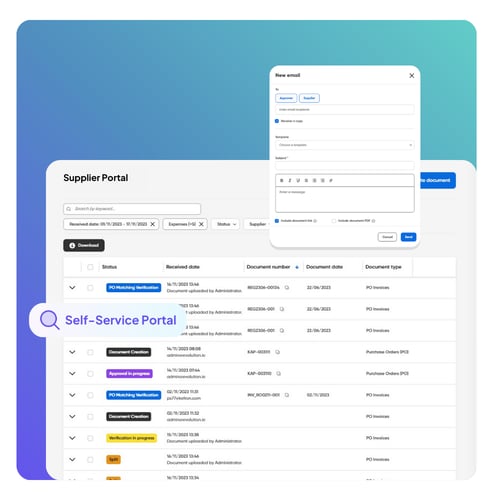
But through the existence of a Supplier Portal, automated AP solutions become a centralised location where accredited suppliers can access their own invoices to learn the status of their invoices. So, the number of requests, reminders and queries are reduced, freeing up time for your AP team to work on other areas.
5. Gain Insights Into Trends
With AP automation gathering and storing documents electronically, the ability to garner detailed insights from the archived data becomes simpler. Reporting can be done in real time, so any insight is as up-to-date and relevant as they can be, allowing the key factors that affect productivity and performance to be identified quickly. Action can then be taken to either improve or maintain those figures.
6. Continued High Productivity Post-Pandemic
It may seem like an overly optimistic prediction, but data is showing that even in the post-pandemic world, high business productivity levels can be enjoyed. Research has already shown that, in general, employees are reacting very well to working from home. In fact, 88% of participants in a recent FlexJobs survey stated their productivity increased or stayed the same while remote working. And some 65% wanted to work permanently from home, and 33% have a hybrid working model after the Covid-19 pandemic is over. With AP automation, either of these scenarios can be facilitated with no upset to the overall operation.
If you would like to talk to a Kefron’s team member about an invoice automation solution that is highly adaptable to business processes and rules, click here.