Beyond the Filing Cabinet — Why Legal Files Storage is a Core Strategic Function for Modern Irish Law Firms
In the contemporary Irish legal landscape, the management of client files and firm records has evolved far beyond a simple administrative chore. Today, legal document storage is a high-stakes strategic function, integral to a firm’s operational integrity, regulatory compliance, and long-term viability. Outdated approaches to legal files storage, dusty cabinets, off-site warehouses, or ad-hoc archiving—are no longer sufficient. Instead, firms must adopt modern, secure, and policy-driven solutions that balance accessibility, compliance with legal documents retention laws, and robust protection against growing digital and physical risks.
Irish law firms are navigating a gauntlet of legal obligations, from the Law Society of Ireland’s mandatory retention periods to the rigorous data protection principles of the General Data Protection Regulation (GDPR). Simultaneously, the threat of cybercrime, ransomware, and catastrophic data breaches looms larger than ever, with a single incident capable of inflicting millions of euros in damages and causing irreparable harm to a firm’s reputation. Compounding these pressures are the hidden but substantial costs of inefficient document handling, which drain valuable billable hours and elevate the risk of malpractice claims stemming from simple version control errors.
This report serves as a definitive guide for Irish law firms seeking to navigate these challenges. It provides a comprehensive roadmap, moving from a detailed analysis of foundational legal documents retention duties to a clear-eyed assessment of the risks of inaction, and culminating in a strategic framework for implementing robust, future-proof solutions. By examining the best practices embodied by professional legal document storage providers, this analysis will demonstrate how a formal, technology-enabled approach is no longer an operational expense, but a non-negotiable investment in a firm’s resilience, profitability, and professional standing.
The Foundation — Understanding Your Obligations in Legal Document Storage
A compliant and defensible legal document storage strategy must be built on a thorough understanding of the non-negotiable legal and professional duties governing Irish law firms. These obligations dictate not only how long records must be kept but also the principles under which they are managed and, crucially, when they must be destroyed.
The Clock is Ticking: Navigating Retention Periods and Legal Documents Retention
The requirement for legal files storage and retention is not arbitrary. It is fundamentally linked to statutory time limits within which legal action can be taken. Retaining client files protects both the solicitor (against professional negligence claims) and the client (who may need the file to pursue or defend litigation).
The Statute of Limitations 1957 (as amended) sets deadlines for initiating civil claims — typically six years for actions relating to breach of contract or tort, and twelve years for recovery of land or documents executed under seal (e.g., property deeds).
The Law Society of Ireland recommends a “plus one” rule: retaining files for the relevant limitation period plus an extra year, ensuring coverage for late-served claims. This equates to seven years for general client files and thirteen years for conveyancing files.
Special circumstances require longer legal documents retention:
-
Files concerning minors: retained until the limitation period expires after they turn 18.
-
Files of mentally incapacitated persons: retained indefinitely.
-
Will drafting notes: retained indefinitely, to evidence testator’s capacity if contested.
For guidance see the Law Society Retention Guidance.
The GDPR Imperative: Data Protection Principles for Legal Document Storage
While the Statute of Limitations compels law firms to retain documents, the General Data Protection Regulation (GDPR) — implemented in Ireland through the Data Protection Act 2018 — introduces an equally powerful counter-principle: the obligation not to keep personal data longer than necessary. For law firms that are responsible for sensitive personal data, balancing legal files storage with GDPR’s requirements is critical.
GDPR Principles Shaping Legal Documents Retention
-
Storage Limitation (Article 5(1)(e)): Personal data must not be kept longer than required. This directly impacts all legal document storage strategies.
-
Data Minimisation (Article 5(1)(c)): Firms must ensure all data is relevant and limited to what is necessary.
-
Integrity and Confidentiality (Article 5(1)(f)): Creates a direct legal obligation to use secure storage solutions for both physical archives and digital records.
-
Accountability (Article 5(2)): Firms must document policies and be able to demonstrate compliance with audits.
The Data Protection Commission (DPC) enforces these rules in Ireland, with powers to issue warnings, conduct audits, and levy fines of up to €20 million or 4% of annual global turnover.
The tension between mandatory retention (Statute of Limitations) and GDPR’s storage limitation is not a contradiction. It requires a robust legal documents retention policy that links each category of file to a valid legal basis under GDPR Article 6 (e.g., “legal obligation” or “legitimate interests”).
The High Cost of Inaction in Legal Document Storage
Failure to implement a professional and compliant legal document storage strategy exposes Irish law firms to severe and interconnected risks. These consequences are not mere administrative inconveniences; they result in tangible financial losses, significant security vulnerabilities, and potentially irreparable reputational damage.
Financial Drain and Operational Inefficiency
Poorly managed legal files storage drains a firm’s most valuable asset — the billable hour.
-
Wasted Billable Hours: Professionals spend nearly 20% of their time searching for documents. For a ten-attorney firm, this inefficiency could cost over €350,000 annually in lost billable time.
-
Version Control Risks: Without structured systems, multiple versions of the same contract or brief circulate, increasing the chance of errors and malpractice claims.
-
Operational Bottlenecks: Slow retrieval of client files delays case progression, client communication, and increases the risk of missed deadlines.
-
Physical Storage Costs: On-site paper archives consume expensive office space, while off-site warehouses still demand ongoing fees.
Security Breaches and Data Loss
Improper legal documents retention creates major vulnerabilities.
-
Physical Risks: Paper archives face fire, flood, pest, or theft damage. Loss of deeds, wills, or client records can be devastating.
-
Cybersecurity Risks: Law firms are prime targets for ransomware and data breaches due to the sensitive nature of legal data.
According to IBM Security’s Data Breach Report, the average global cost of a data breach in 2023 was €4.43 million. Costs include breach remediation, regulatory fines under GDPR, and potential litigation for damages.
Eroding Client Trust
The solicitor-client relationship is built on confidentiality. Poor legal document storage practices — whether through inefficiency, misplacing files, or breaches — erode client trust. This reputational damage can be more costly than financial penalties, impacting future client acquisition and long-term firm viability.
Building a Resilient Strategy for Legal Document Storage
Transitioning from a reactive or ad-hoc approach to a resilient, professional legal document storage strategy requires a structured framework. This involves adopting a lifecycle approach to information governance and leveraging both secure physical storage providers and digital legal management systems.
The Document Lifecycle: A Framework for Legal Documents Retention
Effective management views records as assets that move through a lifecycle: Active, Semi-Active, Inactive, and Disposition (destruction or archival). Governing this cycle requires a formal legal documents retention and destruction policy, which:
-
Defines retention schedules for every record type.
-
Outlines transfer processes between lifecycle stages.
-
Establishes authorisation protocols for destruction.
-
Provides accountability through a Data Protection Officer or senior partner oversight.
For frameworks see ISO 15489 – Records Management Standard.
Modernising Physical Storage: Professional Off-Site Legal Files Storage
For semi-active and inactive paper records, professional off-site legal files storage is far superior to self-storage. Leading providers deliver:
-
Security & Environmental Controls: 24/7 monitoring, fire suppression, climate-controlled vaults.
-
Auditable Chain of Custody: GPS-tracked vehicles, barcode systems, and documented tracking for compliance.
-
Online Management Portals: Enabling firms to search, request, and track records instantly.
-
Scan-on-Demand: Bridging paper and digital worlds with secure scanned delivery.
-
Certified Secure Destruction: Issuing Certificates of Destruction to prove compliance with GDPR.
Embracing Digital Transformation: Legal Document Management Systems (DMS)
For active files, a legal DMS provides transformative gains in efficiency, compliance, and client service. Unlike generic cloud tools, a DMS supports legal document storage by offering:
-
Matter-Centricity: Organised by client matters for clear visibility.
-
Advanced Search & OCR: Full-text search across all records.
-
Version Control: Automatic history tracking prevents outdated drafts.
-
Email Management: Direct integration with Outlook or Gmail.
-
Compliance & Security: End-to-end encryption, role-based access, audit trails.
-
Integrations: Linking practice management, billing, and e-signature tools for workflow efficiency.
Refer to Gartner – Legal Tech Market Guide for insights into document management systems for law firms.
The Path Forward — Implementing Your Professional Legal Document Storage Solution
Developing a robust legal document storage strategy requires careful planning and cultural adoption across the firm. A structured roadmap ensures compliance, security, and long-term efficiency.
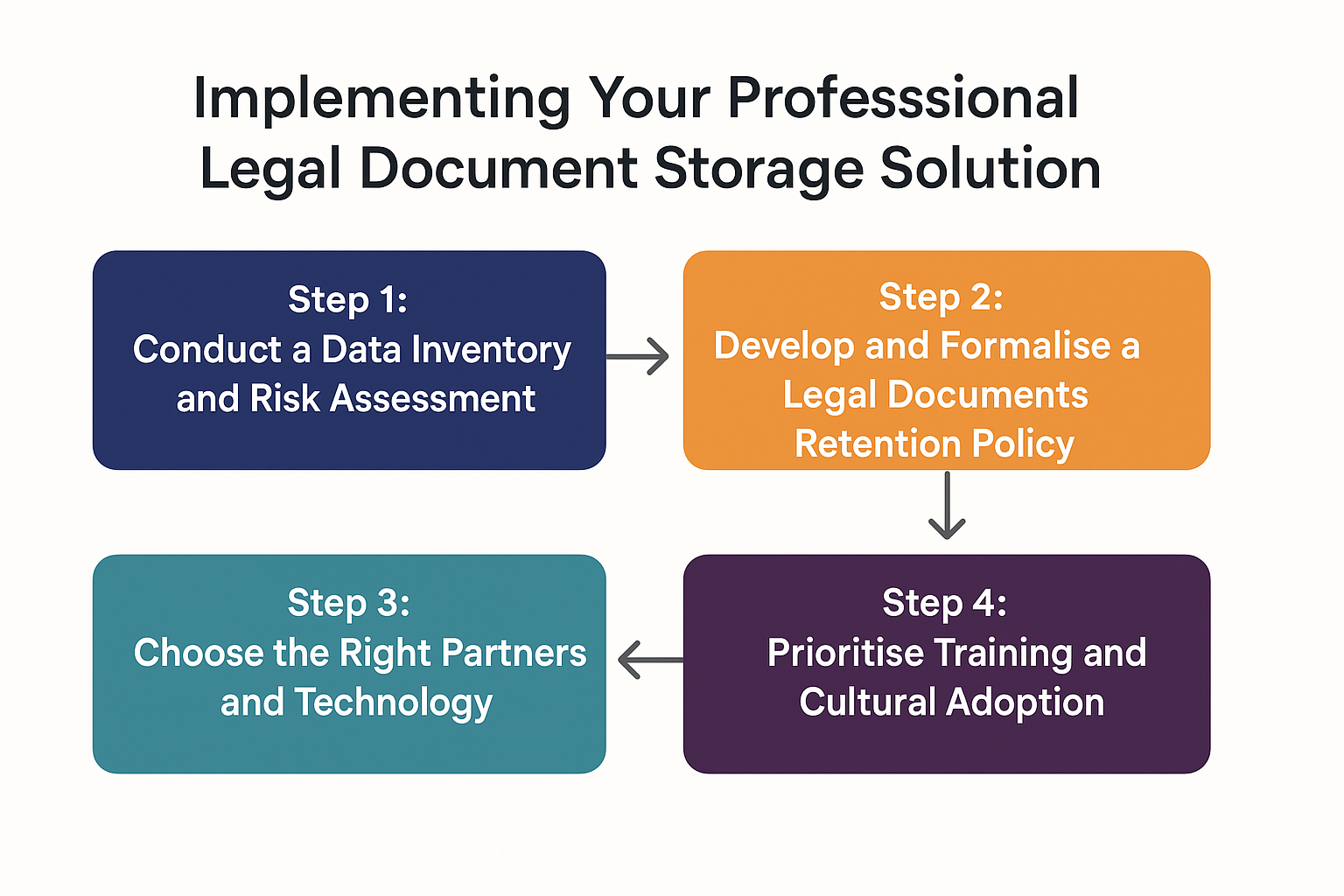
Step 1: Conduct a Data Inventory and Risk Assessment
Start by auditing all current repositories, including filing cabinets, servers, employee devices, and cloud systems. This process aligns with GDPR’s Record of Processing Activities (ROPA). It identifies gaps in legal files storage security, inefficiencies, and compliance risks.
Step 2: Develop and Formalise a Legal Documents Retention Policy
Using insights from the inventory and legal requirements, draft a central legal documents retention and destruction policy. This policy should:
-
Define schedules for all file types.
-
Specify storage methods (digital and physical).
-
Outline authorised destruction procedures.
-
Assign accountability to a Data Protection Officer or senior partner.
Step 3: Choose the Right Partners and Technology
Select secure off-site providers and digital DMS solutions. Evaluate based on:
-
Certifications: ISO 27001 for information security.
-
Chain of Custody: GPS-tracked transport and auditable logs.
-
Portal Functionality: Online inventory, retrieval, and scan-on-demand.
-
Compliance Features: Built-in audit trails for GDPR and professional standards.
Step 4: Prioritise Training and Cultural Adoption
Policies and systems only work if staff adopt them. Train your team on the firm’s legal document storage strategy, emphasising that governance is a shared professional responsibility. This ensures consistent compliance and efficient workflows.
Why Choose Kefron for Legal Document Storage in Ireland
For Irish law firms, compliance and security in legal document storage are not optional — they are business-critical. At Kefron, we specialise in helping firms manage sensitive client records with solutions that balance compliance, efficiency, and security.
Secure and Compliant Legal Files Storage
Our off-site storage facilities are purpose-built for legal records. They feature 24/7 monitoring, strict access controls, fire suppression, and climate-controlled vaults to safeguard deeds, wills, and high-value files. Every box and file is tracked with barcode systems and GPS-enabled transport for a complete audit trail.
Policy-Driven Legal Documents Retention
Kefron works closely with firms to design tailored retention schedules that align with the Law Society of Ireland’s file retention guidelines and GDPR storage limitation principles. Our solutions ensure files are retained for the legally required period and securely destroyed once compliance obligations expire.
Bridging Physical and Digital Records
Through scan-on-demand and digital delivery, we help firms access archived files instantly, supporting hybrid practices that combine physical legal files storage with modern digital document management systems (DMS). This ensures quick access for solicitors while maintaining strict governance.
Total Compliance, Total Confidence
Every service includes Certificates of Destruction, detailed reporting, and secure digital delivery options. With Kefron, law firms gain complete confidence in their legal document storage strategy, reducing risk while increasing efficiency and client trust.
Learn more about Kefron’s Legal Document Storage services and how we support compliance, security, and efficiency for law firms across Ireland.

Conclusion: Future-Proofing Your Practice with Legal Document Storage
The management of client records in Ireland has evolved into a strategic pillar of every modern law practice. The convergence of statutory duties under the Statute of Limitations, GDPR’s requirements, cybersecurity risks, and the operational drag of inefficiency makes a professional legal document storage strategy indispensable.
The risks of poor legal files storage — from lost billable hours and missed deadlines to multi-million euro data breach fines — are simply too high. Instead of treating storage as an administrative burden, law firms must view professional legal documents retention and management as a long-term investment in resilience, profitability, and client trust.
By adopting a structured, policy-driven, and technology-enabled approach — often blending digital document management systems with secure off-site physical storage — firms achieve far more than compliance. They create efficiency, build stronger security, and transform archives into powerful knowledge assets.