If your finance team still treats late payments or late invoice payment as something to “get around to when cash flow allows,” it’s time to rethink, fast.
The UK government has announced what it calls the strictest late payment law reforms in a generation, introducing mandatory rules that will transform how large businesses pay their suppliers. These changes are not optional, they’re being written directly into legislation.
Fail to comply, and you won’t just be dealing with supplier frustration. You could be facing:
-
Fines running into millions
-
Regulatory investigations
-
Public “late payment” reports that damage your brand reputation
This isn’t scaremongering. It’s the new reality of overdue payments in the UK and it’s coming fast.
Why the UK Is Cracking Down on Late Invoice Payment
The government’s position is clear: late payments are killing small businesses.
-
Over £11 billion is drained from the UK economy every year due to late invoice payment.
-
More than 1.5 million SMEs are affected annually.
-
For many suppliers, waiting 60, 90, or 120 days for payment isn’t just inconvenient, it’s the difference between survival and closure.
SMEs, contractors, and freelancers make up the backbone of UK supply chains. When they collapse, everyone suffers, including the large companies that caused the delay.
That’s why ministers are drawing a hard line: overdue payments will no longer be tolerated and excuses won’t count.
Impact of Late Payments: Key Statistics
Overdue payments are a critical issue in the UK business landscape, with significant economic and operational consequences. Understanding the scale of the problem underscores why the government’s crackdown is both urgent and necessary:
-
£11 billion each year is drained from the UK economy due to overdue payments, severely impacting business cash flow.
-
Approximately 38 UK businesses close every day because of cash flow problems linked to delayed payments.
-
Over 1.5 million SMEs are affected annually, facing payment delays that threaten their survival and growth.
-
Up to 30% of SME failures are directly connected to delayed payments and the financial strain they cause.
-
Around 33% of SMEs wait 60 days or more to receive invoice payments, with some waiting up to 90-120 days.
-
Late payments add an estimated 8-10% extra cost to suppliers through interest, administrative expenses, and lost investment opportunities.
-
Since enhanced enforcement powers, investigations and fines by the Small Business Commissioner have increased tenfold, demonstrating stronger government action.
-
More than 60% of CFOs recognize that improving payment terms and automation is crucial to reducing risks.
-
Public sector reforms mandating 30-day payment terms have cut delays by roughly 20% among government suppliers.
The message from these statistics is clear: overdue payments impose real costs and risks. Government reforms seek to protect SMEs while compelling large businesses to modernize payment practices or face penalties.
Key Late Payment Law Reforms Every Business Must Act On
The UK government is no longer treating unpaid payments as a cultural issue. It is now a compliance obligation, and every large organisation that relies on late invoice payment tactics must adapt before penalties take effect.
1. Late Payments Capped by Law at 60 Days
A new late payment law will legally restrict supplier payment terms to a maximum of 60 days. No industry tradition or contractual clause will override this. After an adjustment period, the cap will fall further to 45 days.
If your company currently relies on 90 day overdue payments, your processes will soon be legally non-compliant.
2. 30 Day Limit to Dispute an Invoice
Under the updated late invoice payment rules, finance teams will have 30 days to verify or dispute an invoice. If no action is taken within that period, the invoice becomes approved by default and must be paid within the legal term.
Slow internal sign off can no longer be used to delay supplier payment.
3. Statutory Interest Automatically Applied to Late Payments
The Late Payment of Commercial Debts Act is being strengthened. Statutory interest will be automatically enforced on overdue payments, with no opportunity to negotiate it away.
Every late invoice payment will now cost extra — not only in supplier trust but in financial penalties.
4. Enforcement by the Small Business Commissioner
For the first time, the Small Business Commissioner will have investigative and fining powers to police overdue payments. Expect:
-
Live checks on payment performance
-
Investigations targeting repeat offenders
-
Multi million pound fines for persistent late payers
Assuming enforcement is weak will be a major mistake.
5. Board Level Accountability for Late Payment Data
Late payment law is moving into governance. Company boards and audit committees will be legally responsible for reviewing and approving supplier payment reports before submission. These reports will be published publicly in directors’ filings.
Overdue payments will become a reputation issue, not just an operational one.
6. Fair Payment Code Ranking: Gold, Silver, Bronze
The introduction of the Fair Payment Code will categorise companies based on how fast they settle invoices.
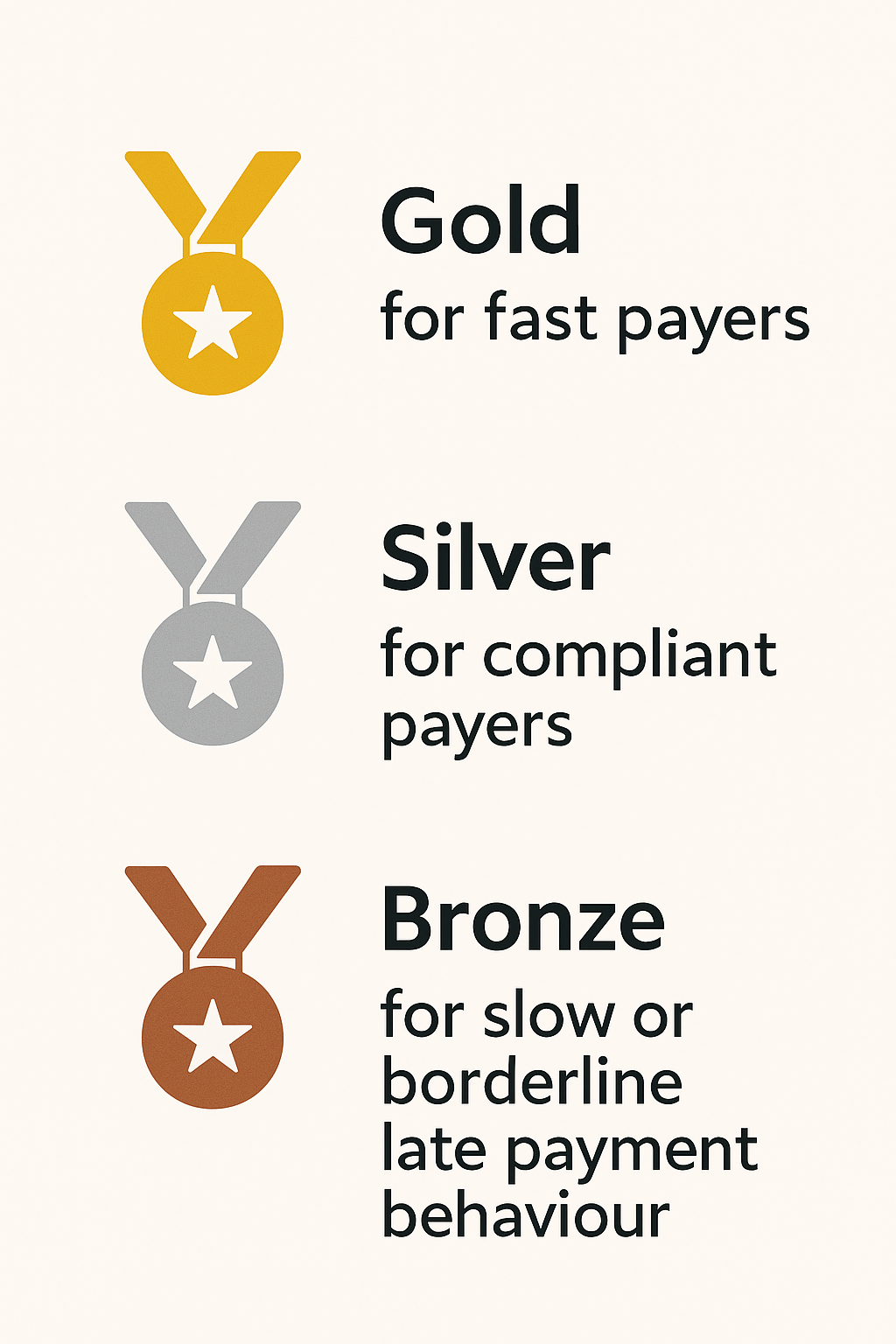
Even if voluntary at first, no brand will want to be publicly ranked as a Bronze late payer.
Late Payment Law Timeline: When the Changes Take Effect
The UK government is not easing into this. The overdue payment law reforms are being rolled out in phases, and large businesses need to act before enforcement begins.
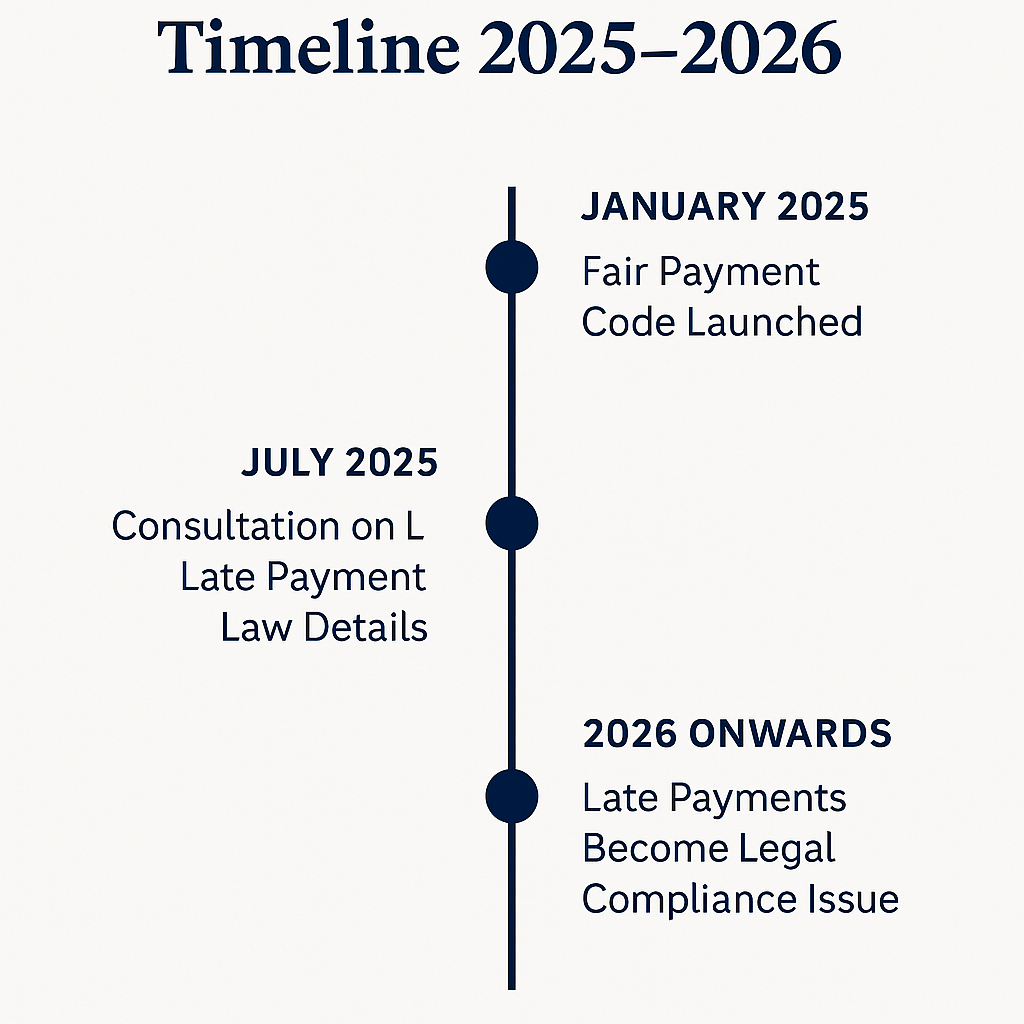
January 2025 — Fair Payment Code Launch
The new Fair Payment Code officially launches. While voluntary at this stage, many large organisations will begin positioning themselves early to avoid being labelled as slow or overdue payment offenders.
July 2025 — Consultation on Late Payment Law Details
The government will publish the full technical framework for the upcoming late payment law. This will include:
-
Final wording on maximum payment terms
-
Clarification of statutory interest rules
-
Enforcement structure for late invoice payment penalties
This will be the last warning before mandatory compliance.
2026 Onwards — Overdue Payments Become a Legal Compliance Issue
From 2026, overdue payments will no longer be tolerated under any circumstances. At this stage:
-
60 day payment terms become legally binding
-
45 day terms activated shortly after transition
-
Statutory interest automatically applied on every late invoice payment
-
Fines issued by the Small Business Commissioner
-
Payment performance reports published in directors’ filings
The message is clear. Finance teams can no longer treat overdue payments as a tactical delay. It will soon be treated as a breach of law.
Why Large Companies Must Act Now on Late Payments
The upcoming late payment law is not about encouraging better behaviour. It is about enforcing financial discipline. Any organisation that continues to rely on loverdue payments as a working capital strategy will face serious consequences.
Risks of Ignoring the Late Payment Law
Failing to prepare for the late invoice payment reforms will expose businesses to:
-
Mandatory fines from the Small Business Commissioner
-
Automatic statutory interest added to every late invoice payment
-
Escalating legal disputes that can no longer be delayed through procedural tactics
-
Public reporting of overdue payments via directors’ filings
-
Negative media attention with “name and shame” lists expected across major outlets
-
Supplier churn as SMEs begin refusing contracts with repeat late payers
Operational Impact on Finance Teams
Beyond penalties, finance operations will face increased pressure. Under the new late payment law, manual or spreadsheet-based finance teams will struggle to meet strict timelines.
-
Shorter payment windows will expose delays in approval chains
-
Invoice verification bottlenecks will become compliance risks
-
Disputes must be logged and resolved within 30 days — not left to interpretation
-
Executives will demand accurate real time payment data to avoid signing off false reports
Unpaid payments will shift from an administrative inconvenience to a high risk governance issue.
Why Invoice Automation Is Now Essential for Overdue Payment Law Compliance
The new late payment law does not just require businesses to promise faster payments. It requires them to prove it. Manual processing, email-based approvals, and spreadsheet tracking simply cannot meet the strict timelines now imposed on overdue payments.
How Invoice Automation Eliminates Late Invoice Payment Risks
Modern invoice automation platforms provide the structure and speed required to avoid penalties and exposure under overdue payment legislation.
Automation enables finance teams to:
-
Process invoices instantly instead of waiting days for manual entry
-
Verify or dispute invoices automatically within the 30 day legal window
-
Schedule payments to meet the 60 or 45 day deadlines without fail
-
Apply audit trails to every dispute to protect against legal challenges
-
Generate unpaid payment compliance reports automatically for board sign off
With automation in place, overdue payments stop being a financial liability and become a controlled, trackable workflow.

Automation Is No Longer a Finance Upgrade — It’s a Compliance Shield
Most organisations do not delay payments because they want to. They delay payments because their approval systems are slow. The new overdue payment law removes the option to blame inefficiency.
Without Invoice automation, overdue payments will turn into:
With automation, every invoice is processed on time — without relying on manual chasing.
A Cultural Shift: Late Payments Are No Longer a Finance Tactic — They Are a Compliance Risk
The upcoming late payment law signals more than a policy change. It represents a mindset shift for finance leaders.
In many organisations, unpaid payments have long been treated as a working capital strategy — a way to hold cash a little longer or delay outbound spend until month-end pressure eases.
That mindset ends now.
Late Invoice Payment Will No Longer Be a Negotiation — It Will Be a Legal Obligation
Under the new framework:
-
Paying suppliers promptly will become a core governance requirement
-
Boards will demand clear, real-time visibility into payment practices
-
Investors will treat repeated overdue payments as a leadership risk signal
-
Reputation damage will come not from internal errors, but public exposure
The companies that continue to treat late payments as flexible will struggle. The companies that treat on-time payment as part of corporate responsibility and brand integrity will thrive.
What To Do Now: Late Payment Compliance Checklist for Finance Leaders
To prepare for the new late payment law, every large organisation should work through this checklist before enforcement begins.
1. Audit Your Existing Payment Terms
-
Identify all supplier contracts currently set above 60 days
-
Flag any late invoice payment practices that rely on manual approvals or cashflow timing
-
Prioritise high-risk categories where disputes or delays are common
2. Review Your Invoice Verification Process
-
Can your team dispute invoices within 30 days — every time?
-
Is documentation stored clearly enough to defend disputes legally?
-
If any step still happens via email, spreadsheet, or PDF — it’s vulnerable
3. Engage the Board Early
-
Under the late payment law, directors will be personally accountable for payment reports
-
Bring them into the conversation now rather than when fines or interest appear on the balance sheet
4. Upgrade Your Payment Technology
-
If your finance team still relies on manual checks, email forwarding, or Excel trackers, compliance will be at risk
-
Adopt invoice automation to:
-
Approve invoices instantly
-
Auto-escalate disputes within the 30-day window
-
Trigger payments before the deadline — without manual monitoring
5. Establish Your Target Fair Payment Code Ranking
-
Decide whether your business aims to be Gold, Silver, or risk Bronze
-
Use this ranking to set internal payment KPIs — and keep competitors from using your late payments against you
The Bottom Line: Overdue Payments Will Soon Be a Legal Liability — Not a Choice
The UK government has made its position clear. Overdue payments are no longer a commercial inconvenience. They are a compliance failure.
The organisations that act now — tightening approval cycles, automating invoice verification, and eliminating manual delay points — will avoid fines, protect their reputation, and strengthen supplier relationships.
The organisations that wait will spend more time firefighting than trading.
Ready to Eliminate Late Invoice Payment Risk?
If you want to stay compliant with the late payment law — and remove overdue payments from your balance sheet before they attract penalties — now is the moment to review your process.
Whether you need:
-
A quick audit of your current payment workflows
-
A full automation roadmap for late invoice payment compliance
-
Or simply clarity on where your exposure sits today
We can help you map it step by step. Let’s talk.