Digitalisation in education is becoming essential for modern learning environments, and Ireland’s Education and Training Boards (ETBs) are no exception. As statutory authorities, ETBs manage schools, colleges, training centres and youth services, delivering education and training to learners of all ages.
Collectively, 16 ETBs oversee more than 250 post-primary schools, 27 Community National Schools, 500+ further education and training locations, and employ over 32,000 staff with budgets exceeding €2 billion annually.
With this scale comes a heavy burden: thousands of student enrolment forms, exam results, HR files, safeguarding records and inspection documents. For this reason, many ETBs are now exploring solutions like student records scanning, HR files scanning, and complete document digitisation for schools.
If your ETB is still relying on paper files or scattered storage, you already know the pain: slow retrieval, inspection stress, GDPR risk and wasted staff time.
Digitalisation in education isn’t just about scanning documents. It’s about enabling faster access, stronger compliance and the freedom to focus on education and training rather than paperwork.
The Old Way: Why Paper Records Are Holding ETBs Back
The Hidden Costs of Paper and Manual Filing
Think about the day-to-day reality for ETBs without digitalisation in education:
-
Enrolment forms arrive in bulk every September. Staff file them in overstuffed cabinets instead of using modern student records scanning processes.
-
Exam results are stored across multiple schools and centres, making retrieval difficult.
-
HR records for teachers and staff are scattered, often duplicated in different offices, where HR files scanning could provide centralised access.
-
Safeguarding and inspection paperwork must be maintained and retrievable, yet too often sits buried in storage.
This paper-first approach creates real problems:
-
Time lost searching for files instead of supporting learners.
-
Risk of non-compliance with GDPR, FOI and inspection requirements.
-
Cost of storage in office space that could be better used for teaching and training.
-
Human error – lost, duplicated or misfiled documents.
The Inspection Problem
With ETBs covering such a wide footprint, one-third of Ireland’s post-primary schools are under ETB management. For this reason, inspection readiness is critical.
Yet relying on paper means scrambling to locate the right files under pressure, creating unnecessary stress and risk. By adopting document digitisation for schools, ETBs can ensure inspectors receive accurate records instantly, supported by digital audit trails.
What Exactly Is Digitalisation in Education for ETBs?
Digitalisation in education is more than just scanning paper documents. It’s a structured, secure process that converts student, staff and compliance records into digital formats that are easy to search, share and safeguard.
For ETBs, this process ensures:
-
A centralised digital repository accessible by authorised staff across schools, colleges and training centres.
-
Searchable records – find what you need in seconds, supported by technologies such as OCR and intelligent indexing.
-
Audit trails to meet GDPR, FOI and safeguarding obligations (Irish Data Protection Commission).
-
Secure storage with encryption and access controls, reducing the risk of lost or misplaced files.
Student and HR Records Transformation
By introducing solutions like student records scanning and HR files scanning, ETBs can eliminate manual filing and create streamlined digital access across all 500+ education and training locations. These digital archives ensure records are accurate, compliant, and instantly retrievable, which is particularly critical for inspection readiness.
Document Digitisation for Schools and Compliance
ETBs also benefit from document digitisation for schools, which standardises processes across multiple sites. From enrolment forms to safeguarding records, digitisation helps meet inspection requirements and ensures GDPR compliance in education. This is no longer just an efficiency gain—it is a compliance necessity for modern education management.
How Digitalisation in Education Works for ETB Records
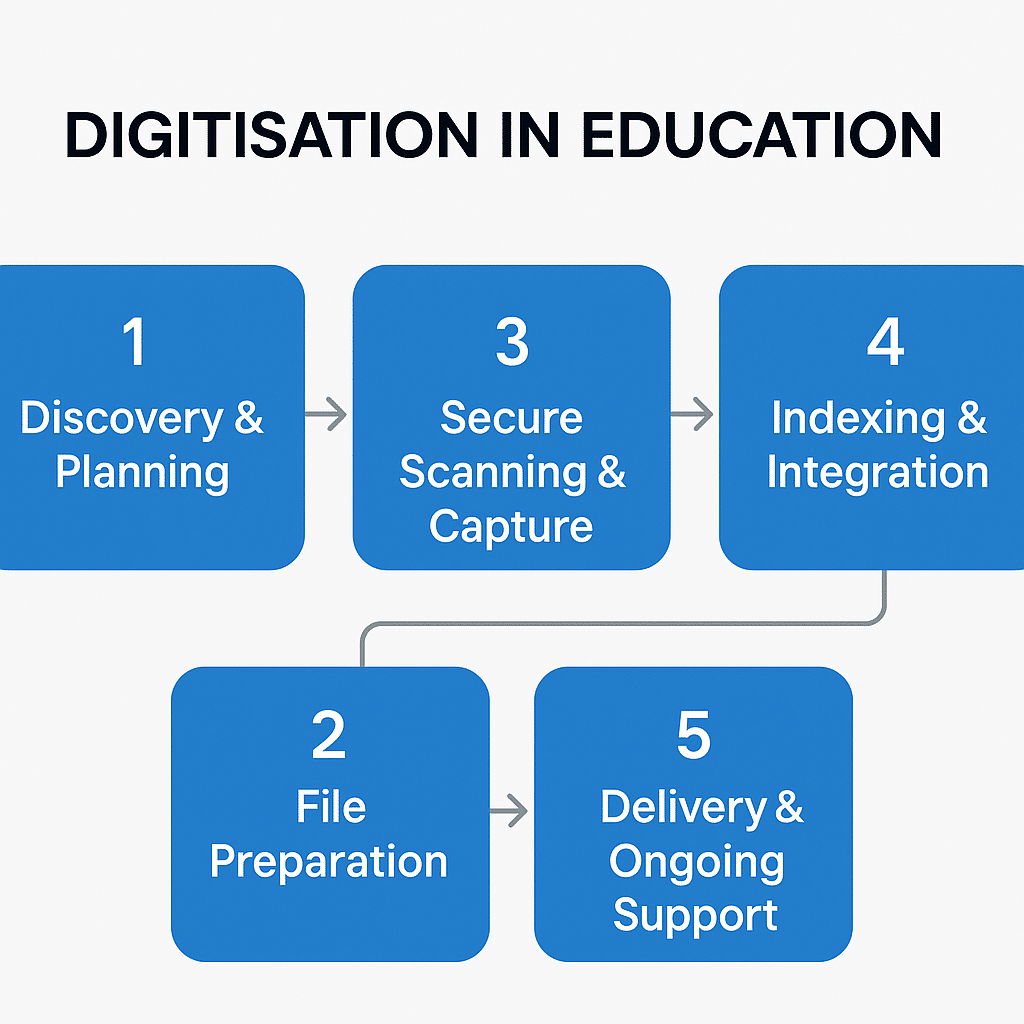
Digitalisation in education is not a one-off project—it’s a structured process that ensures ETBs can transition from paper-heavy systems to fully searchable and secure digital records. From student records scanning to HR files scanning, the process is designed to improve efficiency, compliance, and long-term data access.
1. Discovery & Planning
-
Review current records across schools, colleges and training centres.
-
Map HR, student and safeguarding files.
-
Identify compliance priorities in line with GDPR in education.
2. File Preparation
-
Organise, clean and prepare documents for scanning.
-
Remove duplicates, staples and sort by category.
-
Ensure readiness for document digitisation for schools to avoid errors and improve efficiency.
3. Secure Scanning & Capture
-
Records are scanned using ISO-certified secure technology.
-
Optical Character Recognition (OCR) and intelligent data capture extract key details such as student IDs or staff numbers, making records fully searchable.
4. Indexing & Integration
-
Digital files are indexed for easy retrieval.
-
Seamless integration with HR, payroll or student systems to simplify record-keeping.
-
Supports compliance with inspection and safeguarding requirements.
5. Delivery & Ongoing Support
-
Files returned as fully searchable digital documents.
-
Continuous support ensures ETBs stay compliant and staff retain long-term access.
-
Backed by recognised digital archiving best practices
Benefits of Digitalisation in Education for ETBs
The advantages of adopting digitalisation in education go far beyond simple efficiency. By embracing student records scanning, HR files scanning, and wider document digitisation for schools, ETBs can transform how they manage compliance, inspections, and day-to-day administration.
Speed and Efficiency
-
Retrieve enrolment forms or HR files in seconds.
-
Eliminate wasted hours spent digging through cabinets.
-
Digital access enables staff to focus on student support rather than admin tasks.
Inspection Readiness
-
GDPR, safeguarding and inspection requirements are easier to meet.
-
Digital audit trails provide inspectors with confidence and reduce stress.
Cost Savings
Improved Security
-
Encryption and access controls protect sensitive student and HR data.
-
Reduced risk of lost, duplicated, or misplaced files.
Better Resource Allocation
-
Staff can redirect efforts to education delivery and community programmes.
-
Less time is spent on administrative burdens, allowing ETBs to prioritise learners.
Real-World Examples of Digitalisation in Education for ETBs
Practical applications of digitalisation in education show how it directly benefits staff, students, and compliance officers across Ireland. From student records scanning to HR files scanning and complete document digitisation for schools, ETBs can see immediate improvements in efficiency, security, and compliance.
- Enrolment Season – Instead of filing hundreds of paper forms, staff upload digital files instantly indexed by student ID. This streamlined approach to student records scanning saves time and ensures no application is misplaced.
- Exam Results – Results can be easily retrieved across multiple schools without duplication or delay. By centralising data through document digitisation for schools, ETBs gain a single source of truth that simplifies record-keeping.
- Staff HR Records – Securely stored and accessible only to authorised HR personnel, digitised files reduce duplication and strengthen data compliance. HR files scanning ensures long-term secure archiving.
- Safeguarding Files – Strictly protected, instantly available when required, and fully auditable to meet safeguarding obligations. Digitisation supports compliance with Irish child protection policies.
How to Choose the Right Digitalisation Partner for ETBs
Selecting the right partner for digitalisation in education is a critical step. ETBs need providers who understand the complexities of handling sensitive records, from student records scanning to HR files scanning, and can deliver scalable document digitisation for schools that ensures compliance and security.
- Education Experience – Look for providers with proven success working with ETBs, local councils, and schools. Experience in the education sector ensures awareness of compliance and inspection pressures.
- ISO Certification and Security Standards – Ensure your partner uses ISO-certified processes for confidentiality, scanning, and digital storage. Security standards like ISO/IEC 27001 demonstrate a commitment to protecting sensitive HR and student data.
- Built-In GDPR Compliance – GDPR must be integrated into every stage of digitisation, from secure scanning to access controls. A trusted provider will demonstrate compliance with Irish and EU data regulations.
- Scalability and Flexibility – Your partner should be able to manage both legacy archives and ongoing student and HR records. A scalable solution ensures your document digitisation for schools continues to grow with your organisation’s needs.
- Support and Consultancy – End-to-end support — from file preparation to long-term digital consultancy — helps ETBs maintain compliance and adapt to future regulatory requirements. Ongoing service is just as important as the initial project delivery.
Kefron’s Expertise in Digitalisation
At Kefron, we have over 30 years of experience helping organisations transition from paper-heavy systems to secure digital records. We understand the unique challenges faced by Education and Training Boards (ETBs) — from student records scanning at enrolment season to long-term HR files scanning and safeguarding compliance.
Our tailored solutions for document digitisation for schools and education bodies include:
-
Secure Scanning Services – ISO-certified facilities with strict chain-of-custody protocols to protect sensitive student and HR files.
-
OCR & Intelligent Data Capture – ensuring records are searchable by student ID, staff number, or keyword.
-
Integration with Education Systems – seamless connection to existing HR, payroll, and student management systems.
-
Compliance-First Approach – built-in GDPR, FOI and safeguarding compliance, backed by ISO 27001 certification.
-
Scalable Solutions – from digitising legacy archives to ongoing management of new student enrolments and exam results.
Our team has worked with public sector organisations, councils, and education providers across Ireland and the UK, ensuring efficiency, security, and inspection readiness at scale.
With Kefron as your partner, digitalisation becomes a smooth, compliant, and future-ready process — enabling staff to focus on learners, not paperwork.
Final Thought: The Future of Digitalisation in Education
Digitalisation in education is no longer optional for ETBs. With over 226,000 further education learners and 32,000 staff relying on effective administration, traditional paper systems cannot keep up. Through student records scanning, HR files scanning, and full document digitisation for schools, ETBs can future-proof their operations.
By modernising HR and student files, ETBs gain:
-
Faster, easier access to records.
-
Lower compliance risk with GDPR and safeguarding (Irish Data Protection Commission).
-
Reduced long-term costs of paper storage and manual filing.
-
More resources and staff time dedicated to learners and teaching.
The future of education record-keeping is digital, secure, and accessible. ETBs that embrace this shift are not just improving admin—they are building resilient, modern education systems ready for future challenges.